
Most businesses don’t realise there’s a problem with their website until results start slipping. Traffic may still be coming in, but leads slow down, conversions drop, or updates become frustratingly difficult to manage. This makes most businesses wonder - what actually needs to change?
At Digitex Technologies, we often see businesses rush into big decisions without fully understanding their options. Some invest in a full redesign when simple optimisation would have worked. Others replatform too early, adding cost and complexity without solving the core issue.
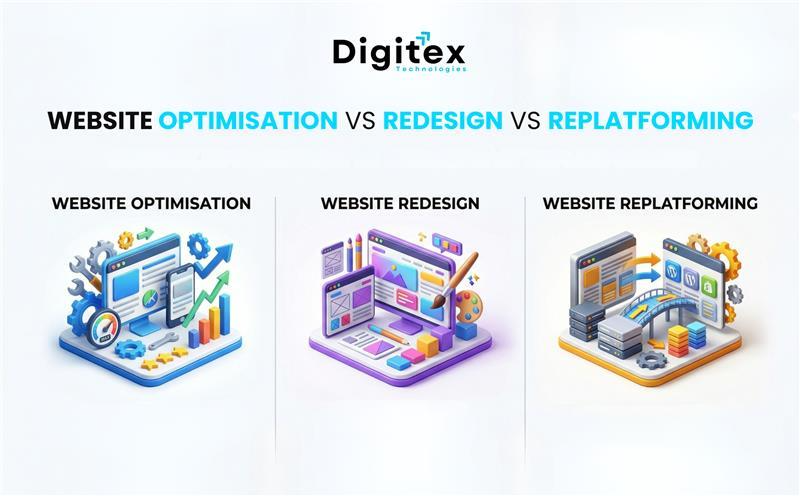
In reality, there are three distinct paths: optimisation, redesign, and replatforming. Each solves a different problem and comes with its own level of effort, risk, and impact.
This guide will help you choose the right path based on your goals, budget, and current setup, so you can make a decision that delivers real results rather than just a visual upgrade.
What Is Website Optimisation?
Website optimisation is concerned with performance enhancement without altering the very structure of your site. It involves achieving better outcomes with what is already there as opposed to starting from scratch.
Optimisation incorporates:
- Optimising page speed and loading time
- Correcting SEO problems and rankings
- Refining navigation and calls-to-action
- Running conversion rate optimisation (CRO) tests
The goal of optimisation is simple. Make your site faster, clearer, and more effective.
Optimisation is the right choice when your website is functional but underperforming. You might have steady traffic but low conversions, or users may drop off before completing key actions. It is also ideal if your budget is limited or you want quick wins without a full rebuild.
In the UK, optimisation plays a crucial role because mobile usage is high. A slow or clunky mobile experience can quickly lose potential customers. Core Web Vitals also directly affect Google UK rankings, so performance optimisation is not optional anymore.
What Is a Website Redesign?
A website redesign focuses on changing how your site looks and feels. It is a graphical and user interface redesign that enhances visitor engagement with your brand online.
This typically includes:
- Creating a new layout and structure
- Updating branding and visual identity
- Enhancing user experiences and content navigation
The aim of web redesigning is to build trust, guide users more effectively, and make it easier for them to take action.
Redesigning makes sense when your website looks old fashioned or fails to attract people. High bounce rates, confusing navigation, or poor conversion rates are often the sign that indicates that your website needs redesigning.
It is important to mention here that a redesign does not change the underlying platform. The technology stays the same, but the experience improves.
In the UK market, this matters even more because users here expect clean, accessible, and trustworthy websites. Here a poorly designed site can damage credibility and reduce conversions.
What Is Replatforming?
Replatforming involves moving your website to a different technology or content management system (CMS). It is a deeper, more technical change that replaces the foundation of your website.
Examples of web re-platforming include:
- Migrating from WordPress to Shopify
- Moving to a headless CMS
- Switching eCommerce platforms
The purpose of web replatforming is to improve the scalability, security, as well as long-term performance of a website.
Replatforming is the right choice when your current system is holding you back. Some indicators of this include: slow performance despite optimisation, difficulty to update, or inability to integrate with modern tools.
In the UK, businesses must also consider GDPR compliance, data handling, and hosting requirements when choosing a platform. These aspects make replatforming a strategic decision rather than merely a technical one.
Key Differences at a Glance
At a high level, optimisation, redesign, and replatforming may seem similar. However, in reality, they solve very different problems and require different levels of investment, time, and risk.
Here is their comparison in a real business sense:
Website Optimisation
Key factors:
- Cost: Low
- Time: Short (typically a few weeks)
- Risk: Low
- Impact: Incremental but measurable improvements
The best way to improve the performance of an existing website without any significant disruption is through web optimisation. It focuses on refining what already exists, which means lower costs and faster turnaround times.
Because you are not rebuilding the entire site, there is minimal risk of breaking functionality or harming SEO rankings. Rather, here you make targeted improvements, for example: speeding up the loading time for key pages, fixing SEO gaps, and reducing friction in user journeys.
The impact is usually gradual rather than dramatic, but it adds up quickly. Optimisation provides the quickest payback on investment to most businesses particularly where conversion rate is the primary issue.
Website Redesign
Key factors:
- Cost: Medium
- Time: Medium (often 6–12 weeks depending on scope)
- Risk: Moderate
- Impact: Significant improvements in user experience and brand perception
A redesign requires more planning and investment because it changes how users interact with your website. While the platform remains the same, the experience layer is rebuilt to improve clarity, trust, and engagement.
The risk is higher than optimisation because it changes the layout, content, and navigation, which can affect user behaviour and SEO if not handled carefully. However, when done right, a redesign can significantly improve how users perceive your brand and how easily they convert.
Website Replatforming
Key factors:
- Cost: High
- Time: Long (often several months, depending on complexity)
- Risk: Higher
- Impact: Deep structural and technical transformation
Replatforming is the most complicated and resource consuming choice which involves content migration, re-integration of functionalities as well as making sure that nothing from the older site is missed when changing the technological foundation of the website.
Since this work requires technical deph, the associated cost and timeline increase significantly. The risk is also higher in replatforming because if the migration is not handled properly, issues like broken links, lost rankings, or integration failures can occur.
When done properly replatforming gives scalability, enhances security, and allows your team to manage and expand the website over time.
How to Choose the Right Approach
Choosing between optimisation, redesign, and replatforming comes down to identifying the real issue.
Choose optimisation if:
- Your traffic is strong but conversions are low
- Your website works but needs refinement
- You want faster results without major disruption
Choose redesign if:
- Users do not trust or engage with your site
- Your brand has evolved but your website has not
- Navigation and user journeys feel confusing
Choose replatforming if:
- You have outgrown your current technology
- Your team struggles to manage or update the site
- Performance, security, or integrations are limiting growth
A simple way to decide is this:
- If the issue is performance, optimise
- If the issue is perception, redesign
- If the issue is capability, replatform
In many cases, a phased approach works best. For example, you might optimise key pages first, then redesign high-impact journeys, and finally replatform if needed.
Common Mistakes to Avoid
Selecting an incorrect solution is one of the greatest errors that businesses can make.
Common pitfalls include:
- Redesigning when optimisation would have solved the issue
- Replatforming without a clear business case
- Ignoring SEO during redesign or migration
- Underestimating costs, timelines, and complexity
In the UK, a major risk is losing rankings on Google due to poor migration handling. Broken links, missing redirects, or slow performance can quickly damage visibility. Even a well-designed site can fail if the underlying issue was not correctly identified in the first place.
Conclusion
When your website is not performing as expected, there can be various reasons behind it. The best way to address such an issue is to understand whether your issue is performance, user experience, or platform capability. Make the decision based on your goals rather than assumptions.
At Digitex Technologies, we can audit your website and suggest you the best course of action based on what your website lacks. After this audit, our experts will send you a detailed plan of how we will fix it with transparent pricing and timeline. This will allow you to make the right decision for your business. Contact our digital marketing agency in London now for a free website audit.